Enter a keyword below to search for articles and products.


Dogs need a well-balanced meal for their adequate growth and development. Different breeds and sizes of dogs require a different amount of nutrients. Puppies are at their growing stage, and hence they require more energy for overall development. Nutrients like fat, protein, carbohydrates, vitamins, minerals, and water help the puppy nourish into a healthy dog. Choosing a puppy food is a crucial decision to make as the type of puppy food you choose directly affects your fur baby’s development in the initial years.
IAMS™ is one of the leading puppy food brands that is known for offering food packed with energy and nutrients to support a puppy’s growing age.
Pet parents often face the dilemma of how to choose puppy food for their fur baby. Puppies often need twice the amount of nutrients compared to an adult dog. While choosing a puppy food, you must look for meal options that are highly digestive and nutrient dense. The food should be packed with vitamins, proteins, fat, and carbohydrates for your puppy’s healthy growth. Some benefits of selecting the right puppy food are:
While home food can be nutritious, it can sometimes not be sufficient for a puppy’s growing body. Hence, pet parents need to depend on formulated puppy food that is packed with the goodness of protein and other essential nutrients to support their fur baby’s growth and development stage. However, how to choose the right puppy food brand amongst so many available options? Read the following to know more.
Moreover, you must also consider your puppy’s breed, size, and weight when confused about how to choose food for the puppy. Smaller breeds of dogs mature faster than larger breeds, this means your puppy’s breed decides how much nutrients it will need for how long. While most puppies can start consuming solid food once they turn 4-weeks old, their transition from puppy food to adult dog food varies depending on their breed, size, and weight. Please consult a vegetarian doctor if you are unsure about your pet’s breed and the amount of nutrients required for its adequate growth.
Different breeds of dogs require a different amount of nutrition for their proper growth and development. Feeding the puppy as per its breed’s requirement ensures that it gets the right amount of nutrients for its physical and psychological growth. Hence, to help you choose the best for your fur baby, we have curated some insights on how much nutrition is required for which breed size.
The physical growth and development of a puppy are at stake during its initial years. Therefore, choosing a diet that meets all its nutritional requirements and provides appropriate nourishment is essential. Caregivers should be mindful of their puppy’s allergies, breed size, and age before selecting a puppy food brand. IAMS offers a wide range of puppy food varieties for different breed sizes based on their nutritional requirements. However, you should consult a vet if you are unsure about your puppy’s nutritional needs and breed.
At IAMS™, we focus on preparing highest-quality food for dogs of all ages and breeds. Our puppy food – IAMS™ Proactive Health™ Starter Mother and Baby Dog – is the ideal pick for your little pooch’s optimal growth and development. Along with being loaded with proteins, vitamins, and minerals, it also contains DHA and colostrum. While DHA ensures healthy cognition for better trainability, colostrum provides essential nutrients that’s only found in the mother dog’s milk. Enriched with best-quality proteins, fiber, and FOS natural prebiotics, IAMS™ Proactive Health™ Starter Mother and Baby Dog ensures healthy muscles as well as digestive system.
Puppies ideally prefer animal-based meals. You can select the best food formula by choosing a puppy food brand that caters to your puppy’s breed size as different breed sizes require a different amount of nutrients for overall development and healthy growth.
Yes, puppies need more energy compared to adult dogs. Hence, they do require special food that can offer twice the amount of nutrients in smaller quantities. Besides, puppies also need to be fed more frequently to support the nutritional requirements for growth and development.
This is subjective to the puppy’s nutritional requirements and allergies. Most puppies rely on animal-based food for their nutritional needs. Nutrient-packed formulas offered by puppy food brands like IAMS are also suggested for providing a well-balanced and nourishing food to your puppy.


Having a puppy in your household never lets a dull day knock on your door. What could be more exciting than having a fur baby live with you? For some of you, it may also be a lifelong dream finally coming true. While everything about sharing your space with a pup sounds delightful, it starts going south when an untrained puppy takes over the house.
Procrastinating the process of house training a puppy can drive your pooch to eliminate in your house and ruin carpets and furniture. This is not a pretty scenario in the long run because not being able to control your little pup can put you and your family into distress. And most first-time pet parents are clueless regarding how to handle and control their furry companion. If you are one of them, here’s everything you need to do to house train your puppy.
This is not something that you take lightly. You need to be determined and consistent with the process if you want this to stay with your pup forever. House training a dog requires patience and perseverance. Create a routine and stick to it. Try to get your puppy used to walking on leash before you start potty training.
Note: You need to know that your dog is new to your house, it will need time to adjust in the brand-new environment. So, make sure that you do not develop a plan that is too overwhelming for your pet.
A routine always helps in the long run, whether it is for us or for our dogs, establishing a routine will help your dog to understand that there is a specific time to eat, play, sleep, or potty. So, with this, your dog will know that there is a particular time to poop as well. It is better to have a dog with a routine than the one who defecates anytime, anywhere.
Taking your puppy out at appropriate times is non-negotiable. Take it out for a walk right after it wakes up, during its play time, and after it eats or drinks because these are the times when dogs are most likely to want to go. Hence, keep a good gap between meals and water, and bedtime, so your pup does not have to hold their business in for too long.
As a dog parent, you must know that for every month of age, puppies can control its bladder for an hour! So, if your pup is 2 months old, it can hold its bladder for 2 hours. However, 6 hours is the limit. Dogs cannot control their bladder for more than 6 hours.
Commands can help pet parents in communicating with their pooch. If you use a command repeatedly for a certain action, your dog will begin to pick up on the relation between your words and the act. For example, if you keep using the phrase ‘go fetch’ while you throw a toy or a stick, your pet will start understanding that it needs to go and retrieve the object. Similarly, when you take your dog out on a leash and want them to defecate, use the phrase ‘go potty’ and point to a particular spot. This will help them realise that they need to go.
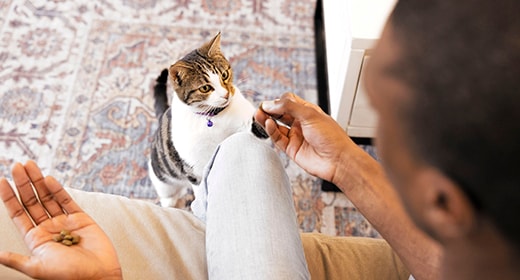
Rewards can help establish a healthy relationship between you and your four-legged friend. These rewards can be in the form of treats or playtime with its favorite toy. It will help you teach new commands while also encouraging good behavior. Make sure you are not showering treats on your pup before the task or action is complete. For example, give your pooch a treat after it has finished its potty round and not when it is in middle of it. Wondering why? Because then, your pup might not finish what it’s doing and have an accident later inside the house.
Note: If you feel that there's little to no progress, consult your veterinarian to rule out medical issues like bladder infections.
Now that you know how to house train a dog, you must understand that it is a time-consuming process. Your pup might take time to learn, however, with consistent practice, your dog will be obedient. Here are a few things you must know before you two get down to training: