Enter a keyword below to search for articles and products.


Your new puppy's first meals at home are very important. Find out what formula your puppy has been eating, and continue feeding this food for a day or two after you bring him home. If you want to change his diet to a premium food such as IAMS™ ProActive Health™ Smart Puppy Original , gradually move him to the new formula and help avoid intestinal upsets by using the following steps:
Day 1: Fill your dog's bowl with 75% of his old food and 25% of IAMS ProActive Health Smart Puppy Original.
Day 2: Mix his former food and IAMS ProActive Health Smart Puppy Original in a 50/50 ratio.
Day 3: Feed your dog a mixture that's 75% IAMS ProActive Health Smart Puppy Original and 25% former food.
Day 4: Feed 100% of IAMS ProActive Health Smart Puppy Original.
To feed a puppy from weaning to 4 months of age, offer a 100% complete and balanced premium puppy formula. To determine each serving size, start with the daily amount recommended by the feeding guidelines on the pet food label, and divide that number by the number of times a day (usually three times) you plan to feed your puppy.
Serve the food at room temperature and remove the bowl within 30 minutes after he's done eating. After four months, you can feed a puppy twice daily on a regular schedule.
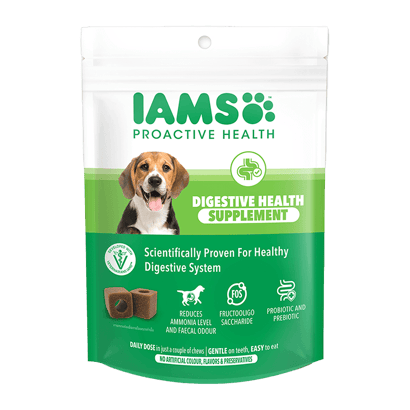
Don't add nutritional supplements to your dog's diet. Adding commercial dietary supplements or 'people food' such as hamburger, eggs, cottage cheese, or cow's milk is unnecessary and might even do more harm than good.


Traditionally, owners of large-breed and mature/senior dogs have known that their dogs may be predisposed to common joint and skeletal conditions—problems that may affect their mobility and overall wellness. The good news is that specially formulated diets and dog care products can help promote skeletal and joint health and assist in maintaining healthy cartilage.
Including specific nutrients in your dog's diet can help maintain healthy joints. Optimal levels of vitamins and minerals are found in IAMS™ dog care products and promote the efficient production of cartilage.
IAMS has formulas that are lower in fat and calories compared with our other adult maintenance formulas. Bones are the framework of the body, and the more weight added to the frame, the more stress joints experience. IAMS formulas such as IAMS™ ProActive Health™ Mature Adult are designed to help keep large-breed or mature dogs at an optimal weight to minimize joint stress.