IAMS PH
How to Help Your Obese Cat Lose Weight

adp_description_block174
Ways To Help Obese Cat

  • Share

Let’s start by asking – would you realize if your cat needed to cut down? 

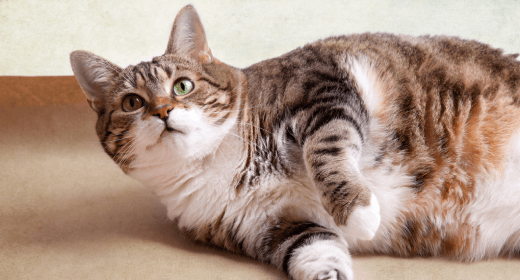
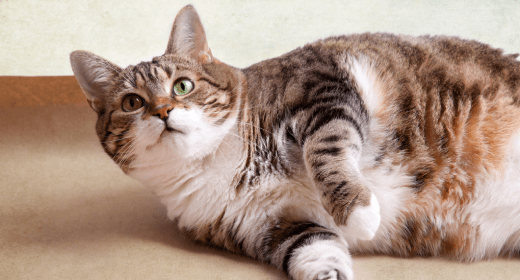
You know your cat is purr-fect. It’s fluffy and has a paunchy belly. But so, what? It could also imply that it is perfectly healthy. Naturally, you may not understand if your fluffball is on the portly side. In fact, overweight cats now appear to outnumber those who have a healthy weight. 

Overfeeding your cat is a big no-no. Even a few additional pounds can increase your cat’s risk of developing certain health conditions, such as type 2 diabetes. It may even prevent your cat from grooming itself properly. Therefore, keeping your cat in shape is crucial to maintain its health, and help it live longer and happier. Well, the good news is that by making some simple dietary and exercise changes, you can assist your overweight cat in losing weight.
 

What Are The Risks Of Obesity?

Obesity is becoming more prevalent in cats, just as it is in humans. It can have long-term consequences on a cat's health, quality of life, and body functioning. Therefore, obesity in cats must be addressed immediately, as it is linked to serious health problems. Here are the risks of cat obesity:

  • Compromised Immune System

When your cat becomes overweight, its immune system gets weakened, leaving it more susceptible to infection. This includes urinary infection as well as 'stones,' which are caused in overweight cats because they’re less active, drink less water, and urinate lesser than healthy cats.

  • Diabetes

Around 80% to 90% of obese cats require daily insulin shots as they are more likely to develop diabetes. But, when their excess weight is eliminated, diabetes can often be reversed.

  • Liver Failure

When your cat’s body senses that it is undernourished, for instance, if a regular food supply is interrupted, the fat is moved from reserves into the liver to be used as energy. But a cat’s body is unable to efficiently control this process, resulting in poor liver function and liver failure. 

  • Difficulty In Grooming

Cats with excess weight have a harder time grooming themselves, which can contribute to skin problems.
 

How Do I Know If My Cat Is Overweight?

  • When gently running your fingers across the side of your cat, you should be able to feel and count its ribs.
  • Then, when you look down at your cat from above, you should observe an hourglass figure. If it looks like a balloon, then your cat is certainly overweight or obese.
  • Finally, you should notice a tiny tuck or upward slope of the tummy when you look at your cat from the side. If the abdomen looks baggy and drags near the ground, that points to the presence of the most harmful and biologically active form of fat, which is abdominal fat.

Here is a chart for you to understand better – 
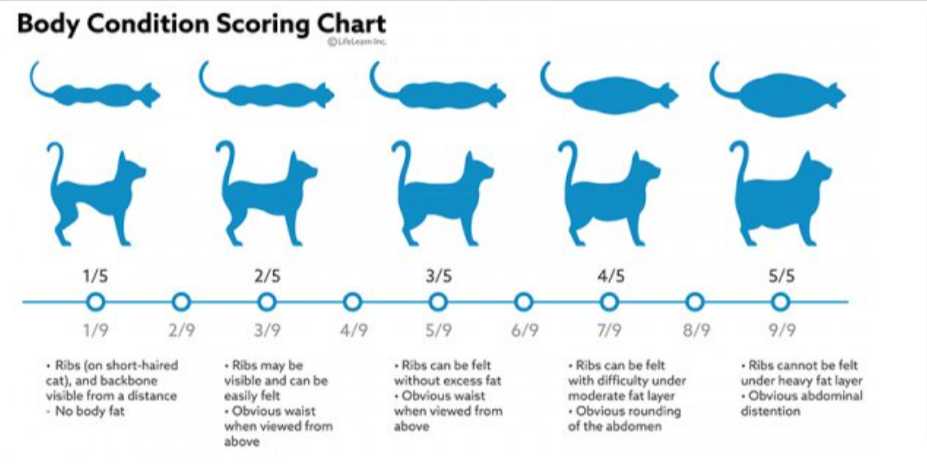
body condition chart

How To Avoid Obesity In Your Cat?

After you get your overweight cat in shape, your goal must be to maintain it for its good health and longevity. Here are some things you should avoid doing to keep your cat from becoming overweight:

  • Avoid Free-Feeding

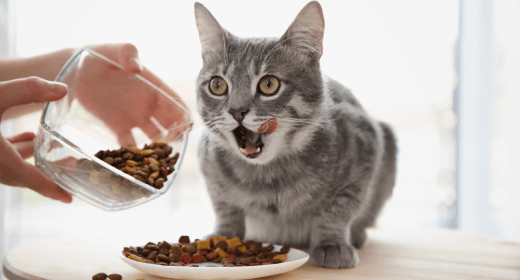
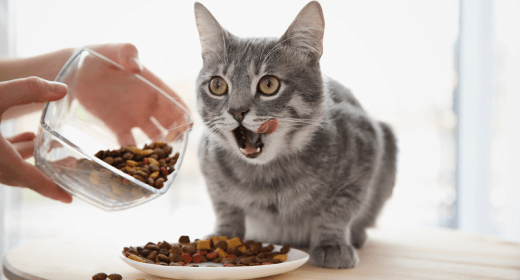
You should avoid free -feeding your cat to prevent it from becoming obese. Set up definite feeding times and keep treats to a minimum.
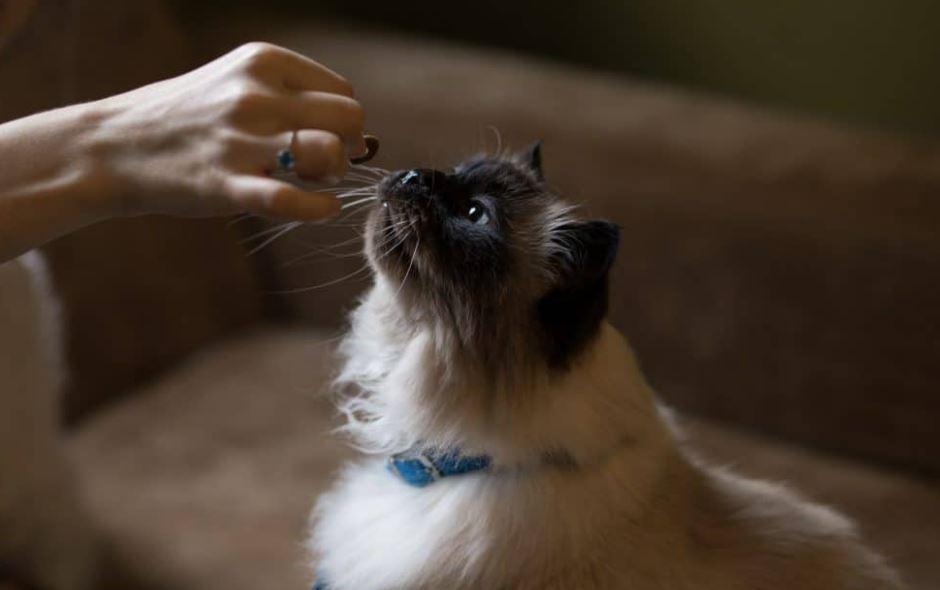
Avoid Free-Feeding

  • Incorporate Outdoor Activities Or Excises Into The Routine

Your cat is at even more risk of becoming overweight if it does not engage in any outdoor activity. To avoid boredom and prevent weight gain, find some interesting toys, set aside playtime, and make it a priority for your indoor cat. Another approach is to go for a walk outside with your cat on a leash.
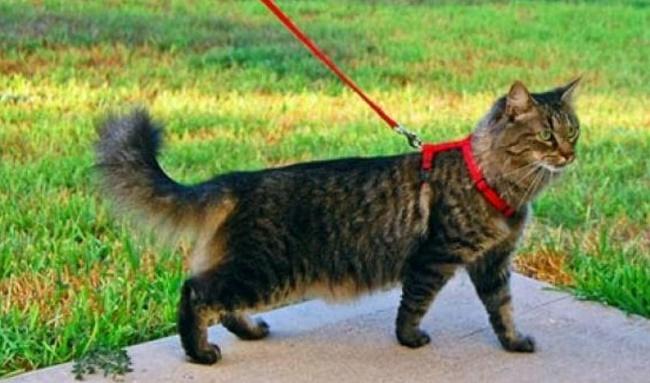
ncorporate Outdoor Activities Or Excises Into The Routine

  • Measure The Servings Each Time

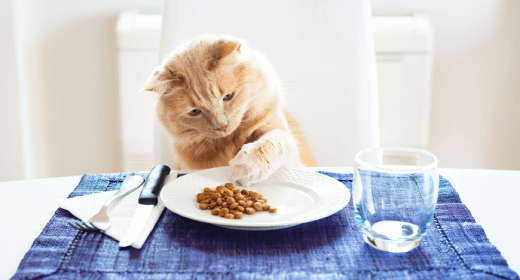
Assess how much food your cat truly needs with the advice of your vet, based on your cat's activity level and desired weight. Once you've calculated how much food your cat requires, measure the food for each meal. Remember that cats are little, and while the portion may appear small to you, some extra kibbles can make the difference between maintaining weight and gaining weight.
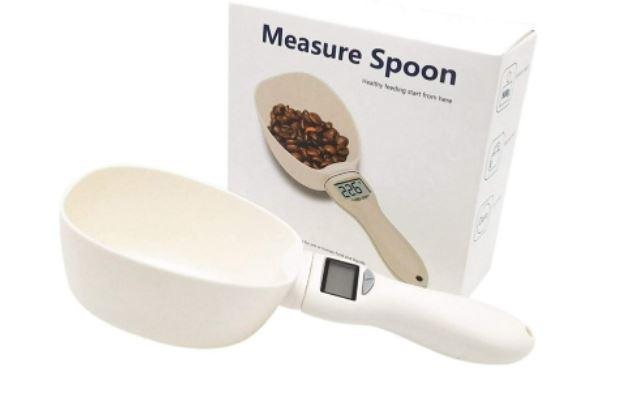
Measure The Servings Each Time

Loosing weight is difficult for cats. Therefore, the best way is to control their weight before they get obese.

  • Play Ball!

Another way to help your cat lose weight is to increase her activity. Provide cat 'trees' for climbing or teach your cat to play fetch. Buy or create your own toys that encourage exercise. Many cats enjoy chasing lights from pointers or flashlights. One ingenious owner throws her cat's dry food ration a piece at a time! Many cats enjoy learning to walk on a leash. You also can use your cat's natural hunting instinct to help her lose weight. Hide several small portions of her daily food ration around the house. If you have a multi-level home, make your cat use the stairs. Use your imagination but be cautious. Don't let a fat cat get exhausted, overheated, or out of breath. Also, keep in mind that an old cat may not be able to exercise vigorously.

Use playtime, grooming, stroking, or conversation as rewards instead of food treats. If you cannot resist the fat cat who begs for food at the dinner table, remove the cat during dinnertime. If you have a multi-cat household, the consistent winner of the food competition sweepstakes is often obese. If this is the case, separate the cats at mealtimes if possible.

  • Patience

Obesity is easier to prevent than to cure, but it is never too late to reverse it—though it requires long-term patience and commitment. Helping cats lose weight is a slow process. If the amount they eat is severely restricted, the cat risks other health problems.

Increased activity, behavior modification (for both you and your cat), and calorie restriction are your weapons against feline obesity. However, with all these things, it is important to expect a few setbacks and plateaus. It will take at least four months for an obese cat to lose 15% of her starting weight. At that point, have another look at your cat's body condition and go on from there.

  • Tips For Starting A Weight-Management Program

Always check with your veterinarian first.
Eliminate all food treats.
Divide the daily food portion into several smaller meals.
Feed a diet formulated specifically for weight loss.
Weigh your cat every two weeks.
Cats should not lose more than 1% to 1.5% of initial weight per week.
Be patient and consistent!


 

FAQ On How To Care For Your Cats Hairball Issues

  1. Should I Worry About Cat Hairball?
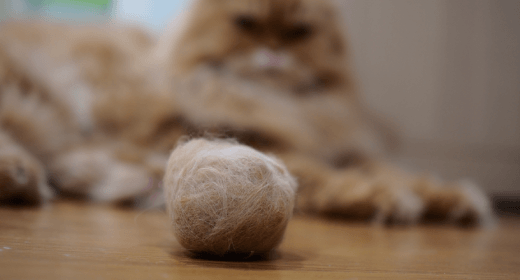
  2. It is natural for a cat to throw up occasional hairballs. But you should only start to be concerned if your cat is coughing out a hairball every few weeks or for more than 48 hours at a stretch. This is a symptom of too much hair ending up in the gut.

  3. How Often Should Cats Have Hairballs?
  4. No matter how long their coat is, cats should only produce one hairball every week. Schedule an appointment with the veterinarian if your cat is vomiting hairballs more regularly or not eating.

  5. How Can I Help My Cat Pass A Hairball?
  6. You should feed your cat lots of prebiotics and natural fibers in its food to help it pass hairballs and maintain a healthy digestive tract. As a result, ensure that your cat is on a hairball-control diet and is getting enough fiber.

  7. How Long Does It Take A Cat To Pass A Hairball?
  8. Generally, the fur travels through the gastrointestinal tract undisturbed and emerges in a stool. The digestion process takes 7 to 12 hours. Sometimes the fur can also accumulate in the stomach and create a hairball. This takes a little longer, but healthy hairballs should be gone in 24 to 48 hours.

  9. Can Cat Hairballs Be Dangerous?
  10. Cat hairballs can be dangerous as they can cause severe blockages in their intestines and pose health issues later. In extreme cases, choking can also lead to death.

  11. What If The Cat Is Overweight Or Senior?
  12. Overweight cats have special nutritional needs in order to promote weight loss or weight management. Likewise, senior cats have special nutritional needs that are better met through a diet designed specifically for them. If an overweight or senior cat has problems with hairballs, feeding an IAMS hairball formula for indoor or senior (age 7+) cats is a great choice.

  13. Should IAMS Hairball Formulas Be Fed Exclusively?
  14. Yes. Mixing other foods with IAMS hairball formulas may compromise the effectiveness of this diet by diluting the nutrients that help reduce the risk of hairball formation. Switching between IAMS hairball formulas and another cat food may also decrease the benefit of feeding this diet.

  • The Importance of Taurine in Cat Food
    The Importance of Taurine in Cat Food
    adp_description_block432
    Taurine Benefits For Cats

    • Share

    Taurine is an important component to all IAMS™ cat foods, such as IAMS ProActive Health™ Adult Original with Chicken.
     

    Taurine is an essential amino acid that is critical for normal heart muscle function, vision, and reproduction in kittens. It is also needed to form the bile salts that aid in digestion. Unlike other amino acids, taurine is found as a free amino acid in body tissues such as the heart and eyes and is not incorporated into proteins
     

    Most mammals manufacture taurine from other amino acids. However, cats cannot manufacture enough and, therefore, must acquire enough additional taurine through diet to meet their needs. In pet food, taurine is naturally found in animal-based protein ingredients and can also be added separately.
     

    How Does Taurine Help?

    Taurine helps in maintaining normal vision, heart muscle function, digestion, normal pregnancy and fetal development, and a healthy immune system. Taurine for cats can only be found in animal-derived proteins.


    Taurine Occurrence In Dogs Vs Cats

    • Dogs:

      Taurine can be made by dogs from two other amino acids: cysteine and methionine. As a result, it isn't regarded necessary in their diet. But since taurine is an important ingredient, you can add it to your pet’s diet due to its numerous health benefits.
       

      Taurine criteria for commercial dog food have yet to be established. If you are worried that your dog may have inadequate taurine or if you need guidance on how much taurine to include in your dog's diet, it is best to consult your veterinarian. 

    • Cats:

      It is vital to include taurine in your cat’s food because cats cannot synthesize it. If your cat's food has too little taurine, it will become taurine deficient, which can lead to a range of major health concerns. For example, taurine could cause your cat’s retinas to degenerate and make your pet go blind. Further, this lack of taurine can stifle growth and make it difficult for you cat to reproduce.
       

      Therefore, the minimum taurine requirement for adult cats in commercial pet food is 25mg/100 kcal for dry food and 50mg/100 kcal for canned foods, according to the Association of American Feed Control Officials Publication, 2018. However, because taurine requirements vary from one cat to the next, it's always a good idea to check with your vet if you're concerned that your pet isn't getting enough.


    Why Does IAMS Add Taurine To Cat Diets?

    IAMS dry cat foods also include taurine as an ingredient to supplement the primary source of this amino acid, which is animal-based protein from sources such as chicken, egg, lamb, and fish. However, these sources can vary in their taurine content, and adding more taurine is a sound approach to ensure optimal taurine levels.Ü
     

    Importance Of Taurine For Cats

    Health benefits of Taurine
     

    Taurine is an amino acid found in muscles, the heart, the brain, and the retina, among other tissues and organs. Unlike most amino acids, taurine does not form cell proteins but has a variety of other functions. Here are some taurine benefits for cats:
     

    • It helps to strengthen the heart.
    • It helps to maintain a healthy blood flow.
    • It helps to protect the retina and vision.
    • ıt enhances your cat’s reproductive health.
    • Its antioxidizing effect aids in the prevention of ageing.


    Why Do Cats Need Taurine?

    Taurine deficiency can cause serious health problems for your cat over time because it is required for many regular metabolic functions. Some of the issues include:
     

    • Immune system weakness - Disease recovery is slow
    • Low energy - Energy levels are affected by nutritional deficits
    • Feline Dilated Cardiomyopathy (DCM) – It is a condition in which the heart becomes enlarged
    • Digestive issues - Diarrhea or vomiting
    • Feline Retinal Degeneration in the Center (FCRD) - Loss of vision with time
    • Problems with reproduction - Infertility or kittens born with a low birth weight and poor growth
    • Problems with health - Taurine impacts blood sugar levels, and taurine shortage can lead to feline diabetes
    • Skin and coat that ae dry and unhealthy – Your cat's fur may grow dry and flaky if he doesn't get enough taurine
    • Problems with the teeth - Tartar accumulation, cavities, and bad breath.


    What Are Some Effects Of Taurine Deficiency?

    • Blindness
      Taurine is essential to the proper development and function of cells in the retina of the eye. If insufficient taurine is present, the retinal cells don’t function properly and may die, eventually causing impaired vision and even blindness. This process is referred to as feline central retinal degeneration.
    • Heart Disease
      Taurine is also necessary for normal function of the heart muscle cells. Taurine deficiency leads to weakening of the heart muscle, which, in turn, can lead to heart failure. This condition is known as dilated cardiomyopathy and can be fatal.
    • Decreased Reproductive Performance And Growth
      Taurine is necessary for optimal reproductive and growth performance. Both the queen and kittens must maintain adequate taurine levels during pregnancy, lactation, and growth to ensure proper structural development.
    • Immune System Disorders
      The immune system of cats may not work properly if they don't get enough taurine. As a result, cats may be unable to fight viruses and become prone to disease.
    • Decreased Energy Levels
      Cats with low energy levels may look fatigued and sedentary.
    • Digestive Problems 
      Taurine for cats also aids in the production of bile salts, which are necessary for fat digestion. Cats may get diarrhea and digestive problems if they don't get enough taurine.
    • Reproductive Issues
      Cats with taurine deficiency can also face fertility issues.
    • Dental Issues 
      Taurine is an amino acid that keeps a cat's teeth strong and healthy. Cavities are more likely to build when there is a lack of it.


    Taurine In IAMS Cat Foods

    IAMS cat foods are formulated with high-quality, animal-based proteins as their primary ingredient. In addition, they are supplemented with extra taurine to ensure balanced levels of essential amino acids. 
     

    IAMS Proactive Health Healthy Adult with Chicken and Salmon are one of the best foods to feed your cat. This nutrient-dense cat food is available in chicken and salmon flavors. These food ingredients act as the first ingredient to promote a healthy body for play. It also contains natural fiber and prebiotics, which help your cat's digestion. What’s more is that it helps your cat develop strong muscles with rich amounts of protein and provides a complete and balanced diet with no fillers. 

Close modal