Enter a keyword below to search for articles and products.
Have you ever wondered about the mysteries behind a cat's purr? It is not just a simple sound, but a blend of feline physiology at work. Cats achieve their signature purr through rapid contractions and relaxations of their laryngeal muscles, around 150 times per second. This creates that familiar, soothing and resonant sound we all adore. And as your cat takes each breath, the airflow caresses these vibrating muscles adding more depth to its purr. In this blog, we will look into the secrets behind this enchanting feline phenomenon.
Purring is a feline’s versatile tool of communication. Sure, cats purr when they are happy and comfy, but they can also purr when they are stressed, in pain, or even when they are hungry – it is like a cat crying for some attention. And here is a fun fact: mama cats purr to bond with their kittens, and kitten sounds are indicators of the little ones telling mom everything is fine.
Let us dive into the details of different cat sounds because they might just be trying to tell you something important.
Cats are like mysterious little furballs, and their purring adds another layer to the enigma. So, what exactly are they trying to convey when they turn on the purr engine?
When your cat is in its happy place – curled up on your lap or basking in a sunbeam – that gentle purring is often a sign of pure contentment. In cat language, it means, 'Life is good right now.'
Cats are known for their independent streak, but when they snuggle close and start to purr, it is a clear sign of love and bonding. It is a cat’s way of saying, 'You are my favorite human, and I adore you.'
Ever noticed your cat purring when you are in the same room but cannot see her? That is her way of announcing her presence, like a cat crying as a GPS locator, 'Don’t worry, I am nearby.'
It is not all sunshine and rainbows. Cats may also purr when they are in pain or discomfort, which can be akin to a kitten sound or cat cry, meaning something is not quite right.
Cats are remarkable self-healers, and purring may have therapeutic effects. The vibrations produced during purring may promote the healing of bones and tissues. I is their natural way of saying, 'I will make myself better,' and it is not unlike the comforting kitten sound that a mother cat makes to communicate love to her babies.
That ecstatic purring when you stroke cats’ fur or tickle them? It is the feline version of laughter. They are loving every moment of your attention, and their purr is a joyful response.
Cats have a unique ability to use purring as a stress-relief mechanism. When faced with a tense situation, they may start to purr to calm their frayed nerves. It is like their built-in stress buster.
Sometimes, it is all about the food. Cats can be quite vocal when they are hungry, and this may include the sound of a cat crying. When being loud, it could mean that the cat said it is dinnertime. It is like a polite request for a meal.
With this information up your sleeve, the next time your furry friend starts to purr take a moment to decode the message. It is like having a heart-to-heart conversation in your cat’s language!
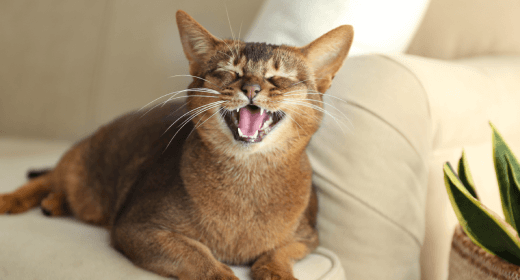
If your feline friend seems to be a chatterbox, you might be wondering what is behind your cat’s meowing. Cats are quite expressive through their meows, and the reasons can vary. A cat’s meow sound may be to seek attention, express hunger, combat loneliness, or signal stress or discomfort. Older cats may meow more due to cognitive changes, and sometimes, boredom can lead to cats meowing excessively. Paying attention to the context and your cat's specific meowing patterns can help you understand its needs and ensure its well-being.
Cats are vocal creatures, and they have an impressive range of sounds to express themselves. Here are five of the most common cat sounds and what they typically mean.
Meowing is an all-purpose communicator in cat language. Cats meow to get your attention, ask for food, or simply say hello. The tone and intensity can convey their emotions, from friendly greetings to a cat crying for urgent demands.
In cat language, this is a clear sign of displeasure or fear. When a cat hisses, it is a warning to back off, and it is best to respect their boundaries.
This quirky cat sound often happens when a cat spots a bird or other prey through a window. It's like their way of expressing excitement and frustration at not being able to catch it.
This kitten sound is a signal that your cat is feeling threatened or territorial. It is a low, guttural sound meant to deter potential intruders.
This is the sound of a cat crying, meaning it is mating season. This cat crying sound is also heard when an unspayed female is in heat. It is a cat's way of announcing its presence and seeking a mate.
Understanding these sounds can help you connect better with your feline friend and respond to its needs and emotions appropriately.
A cat’s meow sound can mean various things, from seeking attention or food to expressing discomfort or simply saying hello.
A cat’s meow sound may be due to hunger, discomfort, illness, or anxiety. It is essential to investigate the cause and address its needs.
You can encourage your cat to meow more by engaging in interactive play, offering treats, and spending quality time with it. Building a strong bond can lead to more vocal communication through your cat’s meow sound.
In cat language, purring can signify contentment. But in certain cases, it can also indicate pain, stress, or a desire for attention, depending on the context. Sometimes, it might even be confused with the sound of a cat crying when they are in distress.
Purring does not always mean your cat is happy. While it is often a sign of contentment, cats can also purr when they are in pain, anxious, or unwell.
Cats purr when cuddling to express comfort and contentment. It is their way of saying they enjoy the affection and feel safe with you.
Cats are generally considered to be low-maintenance pets. However, that’s nothing but a myth. You need to care for a cat the way you would care for any baby, especially with regards to its health and overall well-being. Although medical treatments are available for most feline illnesses, prevention is always better than cure. Cat vaccinations, such as the anti-rabies and FVRCP vaccine, protect your furry friends from deadly infections like rabies. But did you know? These diseases are transmissible to humans as well. Yes. So, when you vaccinate your cat against such medical conditions, you also reduce the possibility of contracting fatal diseases from your own pet.
Feline vaccines are scientifically developed to boost the cat’s immunity and fight fatal diseases. Even though there is no ‘one size fits all’ protocol for immunization, veterinarians suggest cat injections depending on your pet’s age, overall health, lifestyle, and breed. Moreover, these vaccinations are primarily divided into two categories – core vaccines and lifestyle vaccines. Core vaccines are essential for every cat irrespective of their lifestyle, breed, and region. Lifestyle vaccines are given to cats after considering certain circumstances.
Administering rabies and other precautionary vaccines from a young age protects cats from falling prey to serious diseases. Mentioned below are essential cat vaccinations that every kitty must get:
These are anti-rabies vaccines for cats. They are given annually or once in 3 years – depending on the type of vaccine you choose – to protect your kitty from the fatal rabies virus. While this disease is fatal for your feline friend, it can also prove terminal for humans. Rabies often spreads through bites or scratches of infected animals. And rabies patients develop signs of aggression, disorientation, and hydrophobia post incubation stage. If not treated in time, rabies often results in fatal consequences for both animals and humans. Hence, anti-rabies vaccines for cats are a must from a young age.
These are 3-in-1 vaccine for cats. FVRCP vaccine prevents cats from three different viruses – feline rhinotracheitis virus, calicivirus, and feline panleukopenia virus. Instead of getting the kitten inoculated three times, you can simply get the FVRCP vaccine. This 3-in-1 vaccine for cats is recommended annually to protect them from highly infectious diseases.
Protect your kitty from leukemia virus by getting them vaccinated. This disease can spread through body fluids like urine, saliva, and feces; hence, FeLV infects cats while grooming or sharing a bowl with an infected cat. This fatal virus can process into various associated conditions such as anemia, lymphoma, or immunosuppression. Hence, the FeLV vaccine is recommended for cats from a very young age. This vaccine consists of two doses spaced three to four weeks apart for kittens and is followed by revaccination a year later for adult cats.
An FPV vaccine also protects your cat from feline panleukopenia. Kittens should receive an FPV shot once they turn 6-8 weeks old. You should also revaccinate your four-legged angel every three to four weeks until the age of 16 weeks. After this, a booster dose should be given between the ages of 1 to 2 years.
Developed to combat 4 diseases, 4-in-1 vaccine for cats protect against rhinotracheitis, calicivirus, panleukopenia, and chlamydia. These 4-in-1 cat vaccine are also called 4-way vaccines or FVRCCP. Feline chlamydia is part of the feline upper respiratory complex and an underlying cause of most early ocular infections. Hence, kittens should receive 4-in-1 vaccine for cats at the age of 8, 12, and 16 weeks, and a revaccination once they turn a year old. Cat parents are also suggested to revaccinate their kitty every 3 years to keep their purrfect pal hale and hearty.
F5 or Fevac 5 vaccines are 5-in-1 vaccines for cats that boosts your kitty’s immune system to tackle five viruses. Getting your kitty inoculated for this combination will ensure that it is safe from a range of fatal illnesses.
Vaccines are built to boost immunity and fight deadly illnesses. However, after getting vaccinated, your kitty might show mild signs of discomfort and other symptoms. These signs and symptoms are nothing but proof that its body is building a defense mechanism to defeat deadly viruses. Side effects of anti-rabies, FVRCP vaccine, or other combination vaccines for cats may include the following symptoms:
Lethargy
Loss of appetite
Vomiting
Fever
Diarrhea
Swelling and redness around the injected area
Ensuring that your feline friend is vaccinated from time to time aids in keeping them healthy and lively. Hence, every cat parent is recommended to plan a proper vaccination schedule for their fur babies.